Structural Drying and Dehumidification in Federal Way, WA
Surfaces look dry long before framing and subfloor are. The drying team keeps air movers and LGR dehumidifiers running until the readings say dry, not until it looks dry.
(888) 509-1696Get the structure measured dry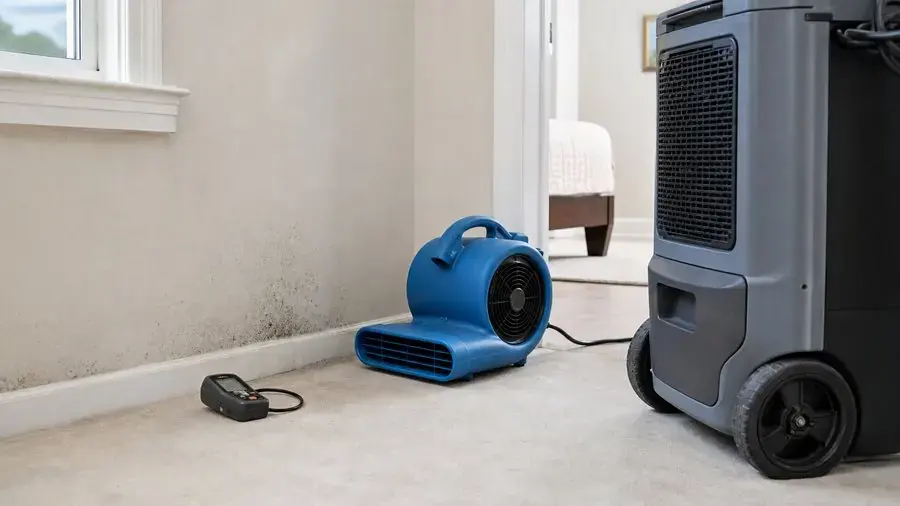
What to do when materials are still wet in Federal Way
- Stop the water No drying plan works while water is still coming in.
- Get standing water out Extraction first; drying cannot remove puddles efficiently.
- Keep the heat moderate Around 70 to 80 degrees helps evaporation.
- Leave the equipment running Turning it off at night adds days.
What does structural drying and dehumidification cost in Federal Way, WA?
In Federal Way, WA, structural drying typically runs $1,500 to $8,000. The range depends on the class of loss, how many rooms need equipment, how many days it runs and whether Class 4 materials like hardwood need specialty drying.
One or two rooms
- Air movers
- LGR dehumidifier
- Daily readings
Several rooms
- Cavity drying
- Several dehumidifiers
- Drying logs
Hardwood or Class 4
- Desiccants or floor mats
- Longer run times
- Full documentation
For a planning range on your own loss, try the water damage cost calculator. The restoration contractor who responds sets the real scope after the moisture map.
Structural drying is the part of a water loss that decides whether problems show up months later. Wet framing, subfloor and wall cavities that are left behind can warp floors, stain paint and feed mold. The IICRC S500 standard sets how drying is planned and how dryness is verified.
What the drying plan is based on
- The category of water, which decides what gets removed first
- The class of loss, Class 1 through 4, which sets how much equipment a room needs
- The moisture map, which shows what is actually wet
- The air inside the house, measured with psychrometric readings
How drying is done in a Puget Sound house
Air moves moisture off wet surfaces and dehumidifiers pull it out of the air. In Federal Way's cool, damp months, outside air cannot do much of that work, so LGR dehumidifiers, which keep working in cooler air, do most of it. Class 4 materials like hardwood, plaster and concrete may need desiccant dehumidifiers or specialty floor mats. The drying team takes readings every day and moves or removes equipment as materials dry.
Still damp days after a leak? Hidden water in walls and subfloor keeps causing damage.
Call about structural drying, (888) 509-1696How dry is dry?
Dry is measured, not guessed. Wet materials are compared to a dry reference of the same material in an unaffected part of the building, and equipment comes out when the wet material reads within 2 to 4 points of it. The daily readings go into the drying log for the claim file. EPA indoor air quality information explains how moisture affects indoor air, and EPA guidance on moisture and mold explains why the 24 to 48 hour window matters. Drying follows water extraction on nearly every job; see also crawl space water damage.
The structural drying process in Federal Way, WA
- 1
Moisture mapping
The tech who does the walkthrough maps wet materials with pinless meters and a thermal camera before any equipment goes down.
- 2
Extraction
The extraction crew pulls standing water with truck-mounted units, so it leaves the building instead of soaking the next room.
- 3
Air movers and LGR
Air movers go in at each room's evaporation load while LGR dehumidifiers pull that moisture back out of the air.
- 4
Dry verification
The drying team logs readings daily and pulls equipment only when materials sit within the IICRC S500 drying goal.
Structural Drying and Dehumidification across Federal Way
The restoration team covers Federal Way ZIPs 98003 and 98023, from City Center and Steel Lake to Twin Lakes, Dash Point and Redondo, plus Des Moines, Kent, Auburn, Milton and Northeast Tacoma. Every neighborhood and ZIP
Related water damage services
Structural Drying and Dehumidification questions in Federal Way, WA
How long does structural drying take?
A contained Class 1 or 2 loss usually dries in three to five days. Hardwood, plaster and concrete take longer.
Why not just open the windows?
In Federal Way's damp months, outside air is often as wet as the air inside. Dehumidifiers remove moisture regardless of the weather.
What does LGR mean?
Low grain refrigerant. LGR dehumidifiers pull more water out of cool, damp air than standard units.
What is the class of loss?
Class 1 through 4 describes how much water is in the room and how hard the materials are to dry, which sets the equipment count.
Why are readings taken every day?
Daily readings show drying progress, steer equipment changes and form the drying log for the claim file.
Can hardwood floors be saved?
Often, if drying starts quickly. Specialty floor mats pull water out of the boards before they cup permanently.
Structural Drying and Dehumidification in Federal Way, any hour
Water keeps moving into drywall, pad and framing until someone pulls it out. The Federal Way restoration crew extracts, dries to the S500 goal and documents the loss.
- Federal Way, WA and south King County
- Open around the clock